How early tax-year planning could help your ISAs grow to £65,000 and boost your pension by £240,000
Recent news about the conflict in the Middle East has been distressing.
While the violence itself is thankfully far from our daily lives, events of this scale can still have wider consequences for the global economy. Indeed, in the Spring Statement, Rachel Reeves noted that growth forecasts had been revised down in part due to the potential economic impact of the conflict.
Geopolitical events often cause short-term market movements, and recent developments have led to some volatility. Depending on how the situation evolves, there may be further fluctuations in the months ahead.
However, history suggests that while conflicts and global tensions can unsettle markets in the short term, they have typically recovered and continued their long-term trend towards growth.
Read on to discover three lessons from history about geopolitics, markets, and the value of patience and discipline.
1. Significant market falls happen more often than not
While global conflicts like the one currently unfolding are relatively rare, market downturns are not. Understanding how common these fluctuations are can help put them into perspective.
Experienced investors recognise that periods of decline are a normal part of the investment journey, rather than something unusual.
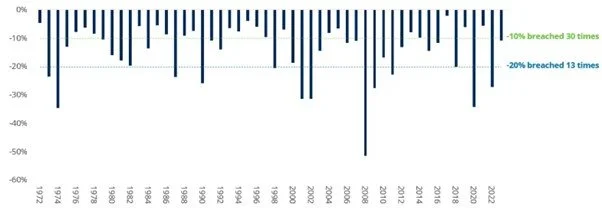
Research by Schroders analysed the MSCI World Index between 1971 and 2023 to examine how frequently markets fall. Their findings showed that double-digit declines in global stock markets occur in more years than they don’t.
The results are shown in the graph below.
Source: Schroders
As you can see, falls of 10% or more happened in 30 of the 52 years, while more substantial falls of 20% or more occurred in 13. Despite the frequency of significant dips, the MSCI World Index has continued to grow over the long term.
In the context of the current conflict, the FTSE 100 has fallen around 5% since the onset, at the time of writing. So, while the recent volatility may feel unnerving, it remains relatively modest compared with the fluctuations markets have experienced many times before.
2. Exiting the market typically means you’ll take longer to recover losses
When markets fall, you may be tempted to exit and cut your losses. This reaction is hardwired into us.
Research published by University College London shows that the brain experiences financial losses in the same way as physical pain. The natural response to pain is to escape from whatever is causing it, and with investment losses, that means selling off and exiting the market.
However, while your instinctive response can be useful for saving you in the moment, it’s less helpful when it comes to helping you over the long term.
Indeed, Schroders' research shows that by staying invested during downturns, your portfolio typically recovers more quickly than if you exit.
The analysis examined the largest market declines of the last century and found that exiting during each one would have been the worst decision. For example, investors who moved to cash after the first 25% drop during the Wall Street Crash in 1929 wouldn’t have recouped their losses until 1963. Meanwhile, those who stayed invested would have recovered by early 1945.
Likewise, investors who exited after the first 25% decline in the 2008 Financial Crisis would still not have recovered their losses by the time the analysis was conducted in 2024. Those who stayed invested would have recovered their losses by around 2013.
So, keeping calm and remaining invested has historically been the quickest course to recovery after even the heaviest falls.
3. Markets trend towards growth in the long term
The key point to remember during periods of market volatility or geopolitical uncertainty is that markets trend towards growth in the long term.
While significant downturns can feel like they are only headed in one direction, history shows that the long-term trend is towards growth.
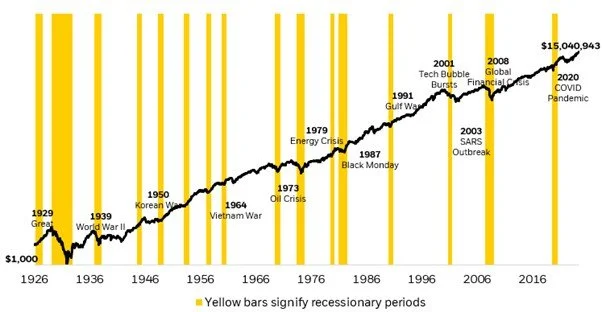
The graph below shows the growth of $1,000 in the US stock market from 1926 to 2024, alongside major events that have caused recessions
Source: iShares
As you can see, even after some of the biggest downturns in history, markets have continued the long-term trend towards growth. And despite all the challenges along the way, $1,000 invested in 1926 would now be worth over $15 million.
History shows us that downturns are common and long-term growth is consistent, and long-term growth has historically been strong enough to recover from every downturn.
Financial planning can help you stay focused on the bigger picture when invest
Periods of geopolitical uncertainty can make the world feel unpredictable, and markets often respond with volatility. However, reacting to short-term events is typically not a good approach for long-term investors, and ensuring you have the structures in place to avoid such a reaction is where financial planning can help.
A well-structured financial plan is built around your personal goals, time horizon, and risk tolerance, and is designed to capture long-term market growth rather than short-term movements.
Diversification is also key. Spreading your investments across different regions, sectors, and asset classes can help reduce the impact of volatility in any single market. When one area experiences turbulence or losses, others may be more resilient, and this can help smooth the journey over time.
A financial planner can help you build a well-diversified portfolio aligned with your long-term goals and strategy, enabling you to weather short-term market movements while continuing to progress on your financial journey. They can also offer a calm and experienced voice during challenging times.
To speak to a financial planner, get in touch.
Email info@mlpwealth.co.uk or call us on 020 8296 1799.
Please note
This article is for general information only and does not constitute advice. The information is aimed at individuals only.
All information is correct at the time of writing and is subject to change in the future.
The value of your investments (and any income from them) can go down as well as up and you may not get back the full amount you invested. Past performance is not a reliable indicator of future performance.